
What Keeps Me Running
The thrill of victory, the agony of the feet

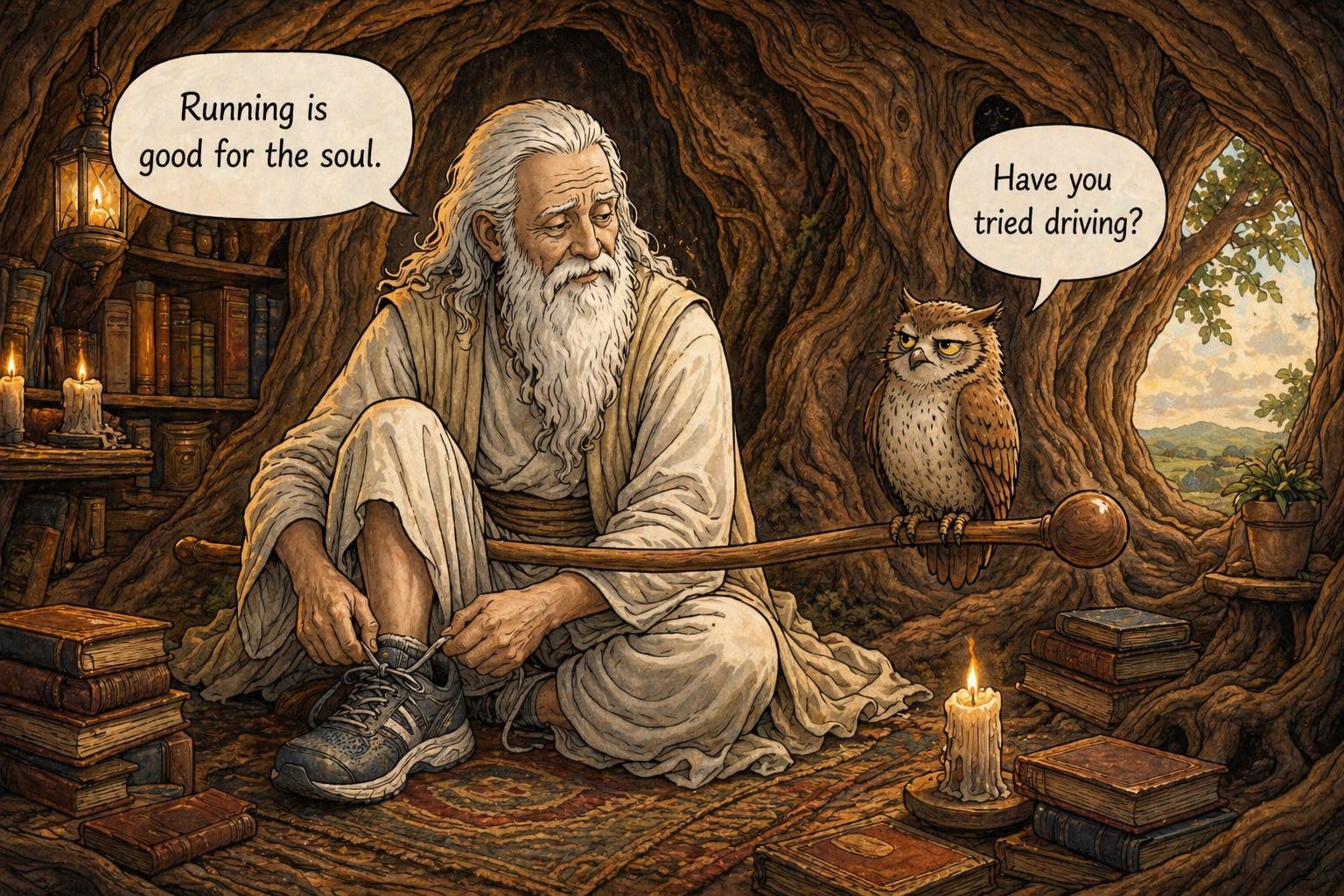
I’ve written before about how, at the age of 13, I was laughed at by my classmates and ridiculed by my gym teacher for not being able to do a single pull-up.
This shaming was a continuation of what I was experiencing at home and in my neighborhood.
It didn’t matter that I was already a superior athlete, outperforming people three and four years older than me. It didn’t matter that Babe Ruth League baseball coaches had been calling my house for a year—once I’d finished Little League—to try to get me to play for their teams in the next level up. It didn’t matter that the football league I played in instituted a new rule called unnecessary roughness because I routinely ran over people on my way to scoring touchdown after touchdown.
It didn’t matter, because in that one gym class, on that one day, in front of my classmates and the man who would become my 8th-grade football coach, I couldn’t do one lousy, stinking pull-up. I hadn’t even known there was such a thing as a pull-up, so when I asked my muscles to perform this new task, they said what the hell are we trying to do here and refused to cooperate.
The same thing happened when I tried to do a dip and a standing long jump, and got timed running the mile.
They could have used a sundial for that last bit.
I was fast enough to steal bases, run people over, and escape bullies, but I’d never run any distance to speak of. When I tried, my lungs and legs got together after about a hundred yards and said it’s time to stop now, don’t you think?
It was humiliating.
As I’ve said before, I had created an alter ego a few years earlier to help me psychologically survive the abuse I was experiencing at home and in my neighborhood. I made a homemade costume, called myself The Mighty Thorn after my favorite comic book hero, and ran around the yard throwing a mallet like it was Thor’s hammer, Mjölnir.
And now, it was time to take The Mighty Thorn physical. To manifest him as a physical specimen and an unstoppable force. To introduce him to the world—not by name, of course; I wasn’t an idiot—but with my body.
The Mighty Thorn Works Out
I started lifting weights. First, it was cinderblocks and an iron crowbar and pull-ups on a beam and dips between two sawhorses and me jumping around like a frog with his ass on fire—all in the cellar. When I felt confident enough, I lifted weights in the gym at school.
It worked. I played 8th-grade football and did really well. So much so that when the next football season came, when I was 14 and going to play alongside my 9th-grade teammates, the varsity football coaches stepped in.
They decided I was too good for freshman football (my fellow 8th and 9th graders), and too good even for junior varsity football (10th and 11th graders), and put me on the varsity football team (mostly 11th and 12th graders).
At the age of 14, I skipped an entire level of development and competition and played with guys three and four years older than me. I was an anomaly; the first kid in the school to do that. And this wasn’t just any old football program. This was a program whose players got scholarships to play football in college. A program that lost only one game a year. That was ranked in the top 10 in the state.
The same thing happened with baseball. In addition to playing varsity baseball at age 14, when the school season ended, I skipped the Babe Ruth League (ages 13-16) and played American Legion (ages 16-19). I was only 14, but they let me play anyway.
Now I was a two-sport varsity athlete playing with guys as much as five years older than me. I was relatively popular at school, I had friends, I had a pretty girlfriend, and I was in all the right Regents-level classes.
The task of making The Mighty Thorn a physical presence was being executed, and I was just getting started.
But my insides were getting ripped apart every day and night at home thanks to the alcoholism, drug addiction, drug-dealing, domestic abuse, crime, abuse, and violence in my home and neighborhood.
Playing sports was my refuge, and so was another thing I’ve not yet talked about — music.
Cue the Music
One of my earliest memories was creating what I called instruments out of household items. A broken tennis racket and a broom were my guitars. Quaker Oats canisters, cooking pot lids, long wooden spoons, and an actual cowbell I found in a field behind our trailer constituted my drum set. A hairbrush was my microphone.
My soundtrack was an eclectic mix of R&B and soul artists, rock & roll groups, and folk-pop musicians and singers of the 1960s. Think Marvin Gaye, The Beatles, and Bob Dylan, and you get the idea.
My mother liked crooners like Mario Lanza, Frank Sinatra, Tony Bennett, and Engelbert Humperdinck. I liked the third one because that was the name of the handsome doctor who delivered me after the sleigh ride (later to be known as a shit-wagon) ride down the mountain, and the last one because he had hump in his name.
My father and all the other men on the road were exclusively country music fans. The Beatles, Bob Dylan, and groups like them were filthy, dope-smoking, long-haired hippie freaks. Frank Sinatra and the other crooners were greasy, thieving wops. The R&B and soul artists and groups were just a bunch of good-for-nothin’ n*****s.
This was not just a difference in musical tastes. It was a war between vastly different worlds. And I had already decided which side I was on.
To put this in perspective, think of my father drinking and smoking and shaking his dirty fist and yelling at Walter Cronkite and the CBS Evening News on the TV as black people fought for their civil rights, women fought for their equal rights, and protesters fought to get the United States out of Vietnam.
Think of my mom in another room singing Strangers in the Night, and There Goes My Everything.
And think of me in my bedroom with my red transistor radio pressed to my ear and singing What’s Going On by Marvin Gaye, Imagine by John Lennon, and Blowin’ in the Wind by Bob Dylan.
I listened to and sang all this and more while the other men on the road joined my father in also drinking and smoking and listening to their country music and shaking their dirty fists and yelling at their TVs and making bigoted and self-pitying, yet also somehow self-congratulatory, comments.
I did this because I had eyes and ears that saw and heard what was different and beautiful and soulful and righteous, ears that had been trained since childhood to detect every nuance in a room’s atmosphere and now were turning that same sensitivity toward music and culture.
I was a boy on a dirt road in an isolated, predominantly white, working-class community, hearing the full spectrum of American music and culture and choosing the most soulful, most emotionally direct, most rhythmically alive versions of it. I didn’t know it at the time, but I was already building the interior life that would eventually produce the man I am today.
Upping My Game
In 1976, my worlds of sports and music came together like a Molotov cocktail.
I had spent my sophomore year as a starter on both the varsity baseball and football teams—by itself, quite an accomplishment. Then something even more consequential happened.
At the big, fancy, end-of-year sports banquet held by the athletic department, funded by all the various booster clubs who supported us, and attended by the public, I was named captain of the varsity football team. This meant that in my junior year, I would be captain of the whole team, seniors and all. It was the first time in the school’s history a junior would be so honored. What made it extra special for me was that I was elected by my teammates for this honor, not chosen by coaches.
I’d been told ahead of time this was going to happen, so I was emotionally prepared. I was also sartorially prepared; I borrowed a sports coat and a tie from a friend, and asked him to tie it for me because I had never been taught how to do that.
I was excited, but I was also sad because I had no one in my family to share it with.
Try as she might, my mother couldn’t get the night off because she was working both the 3 pm-11 pm and 11 pm-7 am shifts at the hospital.
My brother had moved away, where and to do what I didn’t know, and I didn’t care.
My father was nowhere to be found. Actually, we’d stopped looking for him. He’d been fired from his job, he was in the midst of a several-week-long drunken bender, and he had not been seen or heard from. I was simultaneously angry and sad that he wouldn’t be there to see my accomplishment. But even more than that, I was mortified he might hear about it and show up at the banquet hall and embarrass me in front of everyone.
That night, I decided I needed to up my game even more. My teammates, indeed, the coaches, and everyone in the room would be counting on me to lead.
Time to Run
In addition to lifting weights, I’d already been running for a couple of years. But only grudgingly and intermittently. On weekends, and other times when I could.
One night, I heard Michael McDonald in another band I’d grown to love, the Doobie Brothers, sing It Keeps You Runnin. I didn’t know at the time the song was about a girl running away from a relationship and the pain she didn’t want to face. I liked the new fusion of jazz and R&B, and McDonald’s soulful baritone, with their former pop-rock sound.
I’d heard and loved another one of their songs, Takin’ It to the Streets, which McDonald wrote about while protesting in St. Louis, where he grew up, which fit with my view of social justice. But this song was about running, and I needed to run.
That night, I thought, I’ll take it to the streets (well, the dirt road), and start running. And keep running.
So, the next morning, while it was still dark out, before school, before anyone got up, with snow on the ground, I got up, went out to the road, and started running, with Takin’ It to the Streets, and It Keeps You Runnin’ playing in my head.
I started at the end of the row of houses across the road. I ran past the first house, where a few years earlier, a boy my age said, while we were standing in my driveway, he was going to get a rope, make a noose, come back, and hang me. His much older cousin, who was in prison for armed robbery, showed him how to do it, he said. He told me to wait there until he got back and hanged me. I remember calling him puss head, and him not coming back. My neck and head were unscathed.
I ran past the next house, where an old man used to come out and throw rocks at any kids who were nearby. Me included. His son, who was a violent alcoholic like my dad and screamed at and beat his kids, also lived in that house. I remember he came home from his construction job one day, and when he opened the door of his truck, empty beer cans spilled out, along with a bunch of pornographic magazines. He also bought old school buses, parked them in a field next to his house, and stuffed them with auto parts, thinking he could sell them or use them in one of his vehicles someday.
I ran past his brother’s house, next door to that. This man also worked in construction, like the others, and was forever coming home with backhoes and bulldozers he said he was going to fix and take back. But they never went back. He came home every day after work, lined his three teenage kids up in the front yard, screamed at them, and took turns kicking them in their behinds, so hard that the force lifted them off the ground. One of them was a girl, another was a developmentally disabled boy, and the third was the golden boy of the bunch. It didn’t matter; they all got the same ritualistic ass kicking.
I ran past the next house, where the bullies were. Where one of the four boys was known to sexually abuse boys younger and smaller than him. Their mother screamed at them all day as she chain-smoked Virginia Slims, drank liters of Coke one after another, chewed the ice, and took what she called nervous pills (Darvon, a now-discontinued narcotic pain medication that was supposed to treat mild or moderate pain and was highly addictive). When her husband came home, she recited everything the boys had supposedly done wrong, and he beat them. Sometimes he’d hit them before his wife had a chance to list their infractions, saying I know you did something wrong, I might as well hit you now and get it over with. And the boys took it out on me.
I ran past the next house, where a more normal family lived. They’d moved there because the man had gotten a job in the area. A white-collar job. They had three girls, and the family must have felt like they’d landed on Mars, or in the Middle Ages, or both, given what was going on around them.
I ran past the next house, where the drug traffickers lived, and their drug den in the woods. More screaming, violence, and thieving there. One of the boys used to sneak onto our driveway at night and siphon gas out of our car. Another worked at a gas station and bragged about how much money he’d stolen from the owner. Those are only two small anecdotes of that family’s criminality.
I ran past the next house, which had cousins of the drug house and grandkids of the big farm farther down the road. When I got to the farm, I sped up. That was the home of the man who sometimes shot at us when we fished in the pond across the road. His oldest son ended up going to prison for raping little boys.
A little further was another of the farmer’s sons. He’s the one whose pickup truck my fish landed in. Nice man.
Then I ran to the end of the road and did the whole thing in reverse. That was only about a mile and a half, but with steep hills. I added to it over time, finally getting up to about three or three and a half miles.
I did this on most mornings. School days. Weekends. Rain, snow, heat. Didn’t matter. I ran so much, and in the wrong shoes, that I damaged my feet and knees. I was DRIVEN to get better and get out.
Pain With Purpose
I knew sports would be my ticket out. So I ran on the road that had given me such pain, and I used that pain to propel me forward and toward a future I wanted.
Now, here I am, nearly 50 years later, running down that road again with these essays.
It’s emotionally painful.
But it’s much better this way.
Because I’m not running away from anything—I’m running toward something.
And I’m still figuring out what that something is.
That’s what keeps me running.